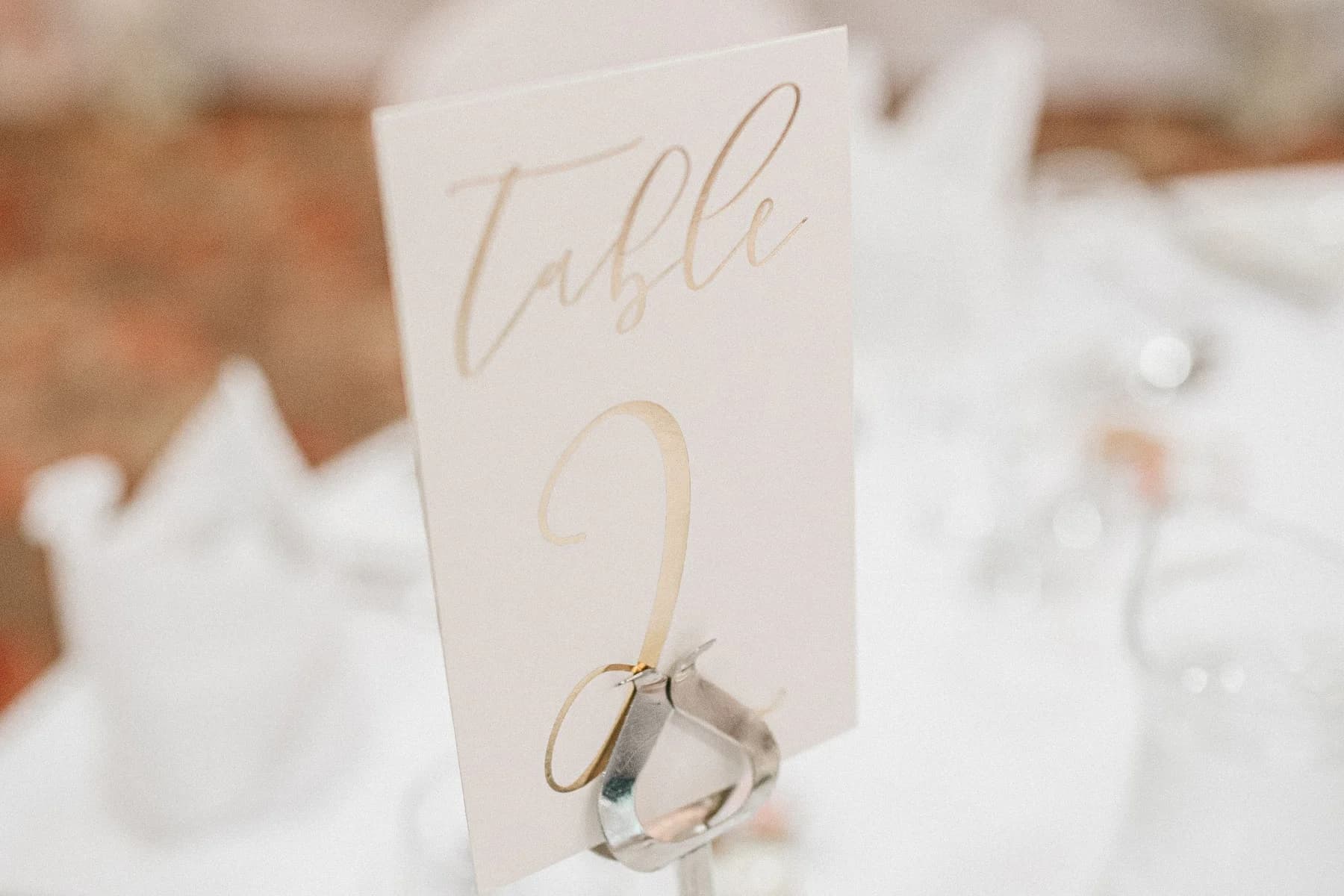
Start your wedding seating chart with current RSVPs and a room layout approved by your venue. Account for guests' practical needs, keep people together when that matters to them, and then fill the remaining places. Table numbers are not a ranking of importance, and dinner does not have to double as a family reconciliation exercise.
If you are planning a 2027 wedding, now is a good time to agree on the approach and ask your venue about possible layouts. You do not need final names on every chair a year ahead. Here is a practical workflow, a worked example for 100 people and ways to handle situations that look simpler on paper than they feel at dinner.
1. Start with people and the actual room
An invitation list is not an attendance list. One invitation might cover two adults and two children, while only three of them have accepted. Record each attendee separately, mark pending replies and decide whether your total includes you as a couple. Agree supplier meals separately rather than automatically placing your photographer or band among dinner guests.
Ask for a floor plan showing doors, the dance floor and service areas. Cotton Bird highlights the importance of clear routes between tables. Confirm actual capacity and spacing with the venue: table dimensions, chairs, centrepieces and serving arrangements all matter. Fitting ten chair symbols on a drawing does not prove ten people will be comfortable.
2. Assign a table or an exact seat?
A table assignment lets guests choose their own chair. Assigned seats need place cards and can help when specific neighbours matter or the catering team needs precise meal locations. Ask how the caterer identifies individual orders. Knowing that one special meal belongs somewhere at table five may not be enough for their service process.
Do not number every chair simply because a template does. Choose the least complicated system that meets your actual needs. At a long table, check the people facing each other as well as those sitting side by side. A carefully planned neighbour is not much help if the person opposite feels excluded from the conversation.
3. Where do you and divorced parents sit?
First decide whether you want a table for two or to share with loved ones. If your wedding party joins you, count their partners too before deciding how much space is needed. A visually balanced head table is not a good reason to separate several couples without considering how they feel about the arrangement.
Ask about sensitive family dynamics privately. Try: “We're working on the seating and want everyone to feel comfortable. Would separate tables work better?” Do not assume divorce automatically means conflict. If distance is needed, give each person a comfortable setting without publishing an explanation. You are arranging a meal, not asking relatives to settle their history.
4. Solo guests do not need a singles table
The GrandWay advises against grouping guests solely by relationship status. Our practical alternative is to give everyone at least one natural starting point for conversation: someone familiar, a shared language or a genuine interest. Being approximately the same age is not a complete social plan.
If a friend knows only you, ask whether they recognise anyone else on the list, or introduce them to a couple of guests before dinner. Avoid giving one outgoing person responsibility for an entire table of strangers. They came to enjoy the wedding, not to provide unpaid entertainment while you are occupied elsewhere.
5. Children, older guests and access: ask rather than assume
A children's table only works if it fits their ages, the parents' preferences and your supervision arrangements. Activity sheets are not a substitute for an adult responsible for the children. A toddler needing help to eat has different needs from a teenager who wants to sit with cousins.
Ask about comfortable access, highchairs and noise preferences. Do not automatically place every older guest in a distant corner. Offer suitable options to anyone with mobility requirements and check the route with the venue. Keep necessary arrangements discreet; personal needs and private family notes do not belong on the public seating display.
6. A 100-person seating example without double-counting
Assume exactly 100 attendees including the two of you, a separate couple's table, and guest tables approved by the venue for a maximum of ten. That leaves 98 people at guest tables. One possible distribution is eight tables of ten and two of nine: ten guest tables plus your table for two. This is arithmetic, not a floor plan suitable for every room.
The two spare places do not automatically accommodate an extra couple together: they are at different tables. Look at moving complete pairs or small groups without exceeding capacity. Alternatively, if you sit among your guests, ten tables of ten already include both of you. Do not add another two seats to the total afterwards.
- 100 attendees = 2 at the couple's table + 98 at guest tables.
- 98 occupied guest places = 8 × 10 + 2 × 9.
- Check highchairs, space needed for mobility aids and supplier meals separately.
- Correct arithmetic does not replace the venue's approval of the layout.
7. Review the plan in three focused passes
First check the numbers: each confirmed attendee appears once, no table exceeds capacity and nobody remains in a note marked “add later”. Next check relationships: is someone surrounded by a language they do not understand, or have you separated partners or a parent and small child against their needs?
Finally, look at it from the staff's perspective. Can they reach seats, identify table numbers and deliver the right orders? Let one person collect suggested changes, then decide together. For every move, name the problem it solves. Otherwise you can spend hours exchanging names and undoing arrangements that were already working.
8. Make the seating display useful, not just photogenic
Minted recommends an alphabetical surname list with table assignments. Guests can find themselves without already knowing their table. You can still use meaningful table names, but adding numbers makes directions easier. “Table 6, Tuscany” is simpler to point out across a busy room than an unfamiliar decorative title.
Review a print sample from the distance at which people will read it. Pale lettering on a mirror or tiny calligraphy may photograph beautifully but be difficult in evening light. Keep phone numbers, dietary information and private notes off the display. Guests need to find their place; staff can receive a separate, appropriately detailed list.
9. When should you finalise a 2027 seating chart?
Agree three deadlines first: guest replies, the venue's final headcount and your printer's production cutoff. Work around whichever relevant decision is needed earliest. You can choose the design well ahead of time, but populate the final names from the most current list possible while still allowing enough time for printing.
For example, a September 18, 2027 wedding might have an August 21 RSVP deadline, follow-ups completed by August 28 and a layout agreed with the venue by September 4, if contracts allow. Confirm printing separately. These are suggested working dates, not an industry standard or a promise about your supplier's turnaround time.
10. Handle late cancellations without rebuilding everything
Update attendance first, tell the venue and ask what your agreement allows. Do not assume an unused place automatically produces a refund. One empty chair does not necessarily justify rearranging the whole reception. Move people only when it improves the remaining guests' experience and can be clearly communicated to the team.
Give the working file a version number or update date and retire previous copies. If the display can no longer be reprinted, prepare a legible correction and brief someone who will greet guests. Update place cards and the service list as well. Three contradictory documents that all look final are harder to manage than one visible correction.
Wedding seating chart questions
Do we have to assign wedding seats?
Not always. A small, informal celebration may work with open seating. At a larger seated meal, assigning tables helps keep groups together and supports service. Agree the approach with your venue.
Do both sets of parents have to sit together?
No. Choose an arrangement that suits their relationships and preferences, whether that means a shared family table or separate tables with people they enjoy. Dinner does not have to be a reconciliation exercise.
How many guests fit at a round table?
Ask your venue to confirm capacity for its actual tables, chairs and place settings. There is no number that fits every round table. Our 100-person example assumes a maximum of ten purely for illustration.
Should guests without partners sit together?
Not simply because they are attending alone. Familiar people, shared language and comfortable conversation are more useful criteria than relationship status. Avoid turning dinner into compulsory matchmaking.
Can we start before all RSVPs arrive?
Yes, as a draft with pending guests clearly marked. Check final assignments and printed materials against current attendance, venue deadlines and printing lead times.
A comfortable evening, not a perfect puzzle
Your 2027 seating plan does not need to satisfy every etiquette rule online. It needs to match attendance, work in the room and give people a chance to enjoy dinner. Prioritise needs and relationships before table names and stationery, and keep a simple change process ready for the inevitable adjustment.